
Kash’s story
Facing brain cancer and moving forward
Life for Kash changed very quickly, following many months of unresolved symptoms and a gut feeling that something wasn’t right. In talking about his own experience, he wants to help increase awareness of symptoms associated with brain tumours, as well as share a message of support for anyone facing similar situations.
 At 33, I was your average family man with a loving wife, three young children aged six, five and two. In June this year I had just started a new job as a Quality Assurance Lead, managing a team and putting quality principles in place for a reputable company in Derby.
Outside of work, I was very much into fitness. I was weight training four or five days a week, walking every day and probably obsessing a little over getting my 10K steps in. I enjoyed podcasts, reading, catching up with friends, going for walks and hikes in the Peak District, and spending time with my people.
Life felt good. Strong, positive and busy.
When things started to change
Looking back, there were signs that something wasn’t quite right.
Probably a year ago now, I started becoming more tired in the gym and wasn’t pushing myself like I normally would. I was having casual headaches too, but I put those down to work stress. I actually blamed myself more than anything.
I’d tell myself I wasn’t pushing hard enough and wasn’t the same man I used to be. I carried on with work, family life, the school runs and hitting to the gym.
Then I started experiencing ocular or aura migraines, where I would see a spectrum of colours across my vision. Even when I closed my eyes, I could still see them. It was quite strange.
After two or three episodes followed by a severe migraines, I went to my GP. I was told it could be a vision issue and was advised to see an optician. I explained that I didn’t think it was my eyes because I could still see the colours with my eyes closed, but I went anyway. The optician told me my eyes were fine.
I went back to my GP and was told I must be “dehydrated” as it was hot currently in the UK. However I was already drinking at least three litres of water a day, and after mentioning further symptoms such as dizziness, weakness, low moods etc, I could tell the conversation was going nowhere. Anyway, me being me, and as I had a lot on with work and life in general, I thought I’ll sort it at a future point.
A turning point
A few weeks later, things got worse. My legs started feeling slightly wobbly, and the aura vision and migraines increased. I was still going to the gym early in the mornings and weight training, so I put the weakness down to simply training too hard.
Then, after the unexpected passing of an old friend, something clicked. I decided I needed to stop putting things off and went to A&E. That decision changed everything.
 “We’ve found a growth”
I went to A&E on my own and was luckily given a CT scan, after which I was taken into a private room and asked if I wanted a family member there – that was enough to inform me of the seriousness. I wanted to deal with it alone, so I simply said “No thanks, lay it on me.”
They told me the CT scan had found a large growth on my brain. They didn’t initially call it a brain tumour, which, strangely, made it feel a little less frightening. But I knew it was serious.
The size of the growth and the sudden change in how the staff were treating me told me enough. They wanted to keep me in overnight and arrange an urgent MRI the following morning.
I called my wife and told her they’d found a “little something” but that there was nothing to worry about. She stayed with me that night anyway, despite me telling her not to.
The next morning, my parents came in too. I’m not someone who particularly likes attention, but family is a big thing for us – in both the good and difficult times.
After the MRI, I was seen by a neurologist and told my scans would be discussed at the multidisciplinary team (MDT) meeting at Queen’s Medical Centre. I knew something serious was happening, but I wanted everyone around me to stay calm.
My attitude was simple: whatever it is, we’ll deal with it.
Preparing my family
After the MDT meeting, the neurologist actually called me that evening. I’d previously told her that I wanted straight answers and no sugar-coating. She couldn’t discuss the results with me over the phone, but she told me they were concerned. In a strange way, I appreciated that call. It gave me the weekend to process things myself and prepare for what might come.
That weekend, one of the things I did was buy a trampoline for the kids. The weather was absolutely roasting, but I knew there could be some difficult weeks and months ahead, and I wanted the kids to have something to enjoy and be distracted by. I was exhausted assembling it with a friend, but hearing their laughs and screams was worth it.
When we went to Queen’s Medical Centre for the MDT meeting, my wife and dad came with me. On the way there, I told them not to worry but that it might be a difficult conversation, so I wanted them mentally prepared.
Hearing the scan results
The doctors were very straightforward with us. They told us they were around 95% confident that I had a grade 4 brain tumour and that they wanted to operate as soon as possible.
My wife and dad found it incredibly emotional, but I had questions. I wanted to understand the prognosis, what the options were with or without treatment, and what the next steps would be.
When we got home, the wider family were there. My mum, grandma, sisters and Caesar, our golden retriever – he’s my little bro.
I sat everyone down and told them not to panic. This was the situation, and we would deal with it.
My mum grabbed my hand and put her forehead against mine. “We deal with it. We always do. Have faith in God.”
I’ll never forget that. That mindset is shared amongst my family, it’s how we deal with whatever life throws at us.
 Surgery
My operation took place soon afterwards. It lasted around six hours, and the team carefully monitored my speech and walking after surgery, as part of the tumour was in an area that could affect those capabilities.
My wife and parents had been waiting for me throughout the operation. When I woke up, I was obviously groggy, but the following morning I was able to sit up, walk, bathe myself and get on with things. That same morning I was also told that they were able to remove 80% of the tumour, but around 20% had to remain because it wasn’t safe to remove it all, which was a possibility I was expecting.
I’m very aware that other people can have a much tougher experience after brain surgery, so I feel blessed that my immediate recovery went as well as it did. I still have the odd speech slip up here and there, but I make jokes about it now – and if you ever meet me, you’ll quickly discover I have dark humour.
 Confirmed diagnosis
About a week later, we received the pathology results. The tumour was confirmed as a grade 4 astrocytoma.
From going into A&E to having surgery and receiving the pathology results took only around two to three weeks. It was incredibly quick, which was good from a medical point of view, but also incredibly quick to process mentally.
Deciding what came next
The oncology team at Royal Derby have been great. They explained the treatment options, including radiotherapy and chemotherapy. They wanted me to start quickly, but after everything that had happened over the previous few weeks, I needed a little time to sit down, understand it and do my own research.
I took four or five days. Then my gut told me it was time to move forward, so I booked in for treatment.
I’m now due to start my six-week course of treatment, and then the journey continues from there.
I’m also speaking with clinics outside the UK about additional treatment options, including immunotherapy, that I may explore alongside my standard treatment. Some of these options are expensive, so we have set up a GoFundMe to help with the costs. That’s quite strange for me because I’ve always been the person donating to other people’s fundraisers. Even the morning after my surgery, I was donating to one. It’s strange being on the other side of that. But I accept it is all positive energy no matter which side you’re on.
 Life has changed, but we move forward
There have obviously been some big changes.
I can’t drive anymore, which has been a big deal because I’ve always been the driver. My wife has had to take over all the trips, and I’ve had to learn not to criticise her driving, which she finds quite funny.
I’ve also had to take long-term sick leave from work. My employer has been very understanding, but it was difficult because I’d only just started the new role and was getting stuck into managing the team and putting new principles in place.
Sometimes you have to step aside.
I can’t train the way I used to either. I’ve been doing some shadow boxing, stretching and light walks, and I still have the urge to lift something heavy. For now, I’m quite happy lifting my two-year-old Hulk of a toddler. Nothing is stopping me lifting my kids despite professional advice.
Learning to receive
One of the biggest changes has been learning to accept help.
I’ve always been the caregiver. I cared for my grandfather right up until his last breath. I’ve always looked after my parents and checked in on people around me to see if they’re okay or need anything.
Now, all those people are checking in on me.
It feels strange because I don’t necessarily feel like I need the help. But I understand that it’s love, and I’m learning to accept it. I’ve always been more comfortable giving than receiving. This experience has taught me to welcome love as well.
My wife has been incredibly strong throughout all of this. My parents, sisters, friends and wider family have all been amazing too.
I’ve told everyone around me that I only want positivity and no negative vibes. Everyone has respected that. I’ve had the odd person come out of the woodwork, speaking about me in the past tense. You can only laugh though – I find it jokes.
 Faith, acceptance and fighting on
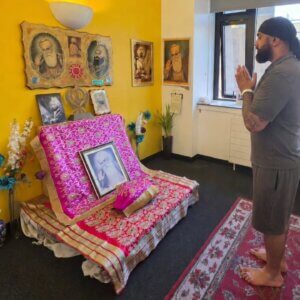
I’m a man of faith and a strong believer in hukam – meaning ‘divine will’. I follow the Sikh faith, however I’ve also read scriptures from other faiths. The knowledge and lessons throughout those scriptures and from history in general gives me hope and strength. Our people have been through far worse, so who am I to complain?
That doesn’t mean I give up or stop fighting. I’ll always fight. But there are some things in life that we simply cannot control, and I believe in accepting those things with gratitude rather than constantly asking, “Why me?”
The doctors have given me a prognosis, but only the Almighty knows how long any of us have. It could be 12 months, 12 days or 50 years. None of us actually knows how much time we have.
A new perspective
It’s changed how I look at life.
Before this, I’d meditate and immediately be distracted by thinking about my to-do list. Now I can actually sit peacefully and meditate. I appreciate grounding, eating whole foods and the simple things a lot more. My wife has also been juicing like crazy.
My ambition has changed too. Before, I was all about providing for my family and following the rat race. I, thankfully, never cared much about materialistic things, but I always wanted to make sure my kids were covered with more than the basics. However, now my mindset is more about trusting the universe and divine will. I’m still grafting, of course, and providing for my family as a parent should, but I don’t stress as much. I know all will work out as perfectly intended.
Sometimes our generation, especially men, put too much pressure on ourselves when we forget we’re only here for a short period.
Don’t stress. Still keep the graft up but trust the process. It’s all good.
 Don’t wait for the perfect time
One thing I’ve thought about a lot is travel. With three young children, we’d always planned to go abroad as a family. COVID stopped that, then each child came along and there was always another reason to wait until they were a little older. Some friends and family would tell us not to bother because young children don’t remember holidays and it’s stressful.
I regret listening to that sometimes. Not because we haven’t made memories – we’ve travelled all over the UK and had some brilliant staycations – but because I’ve realised that you don’t always need to wait for the perfect time.
Sometimes you just have to do the little things. I’m actually writing this while we’re staying in a UK lodge on a family holiday.
Looking ahead
I don’t know exactly what the next few months or years will bring. I know I have treatment ahead of me. I know there may be difficult days, and there will be good days.
Most importantly I know that I’m surrounded by people who love me, and I’m going to keep moving forward.
I’m grateful for what I have, accepting of what I can’t control – and determined to do everything I can with what I can control.
I hope that by sharing my story, someone else might recognise that something isn’t quite right and feel confident enough to push for answers. And for anyone who has received a brain tumour diagnosis, I hope they know that they don’t have to navigate it alone. There is support out there, there are people who understand what you’re going through, and there are still plenty of reasons to appreciate every single day.
Shout out to Brain Tumour Support for being there for me, always ready to help and just a phone call away whenever I need them.
And I appreciate you all for reading.
Kash Raju | September 2026
You can follow Kash on Instagram and TikTok: @kashraju_
Need support?
If Kash’s story resonates with you, or you are supporting someone affected by a brain tumour diagnosis, you don’t have to face it alone. We are here to support you and your loved ones at any stage. Our support line is open Monday to Friday, 9am to 5pm. If you need to leave a message we will contact you as soon as possible.
Help make support like this possible
Brain Tumour Support receives no government or statutory funding. Our services are only possible because of the generosity of the people, businesses, funders and communities who choose to stand alongside families affected by brain tumours.
Your support helps provide specialist emotional and practical support, counselling, support groups and ongoing guidance for people affected by any type or grade of brain tumour.
Make a donation today and make a difference
