Heather’s volunteer story
Finding purpose through volunteering
It was ten years ago this week that I had to medically retire from my employment as a Staff Nurse at West Cornwall Hospital, and in the process ended a 32-year career in nursing.
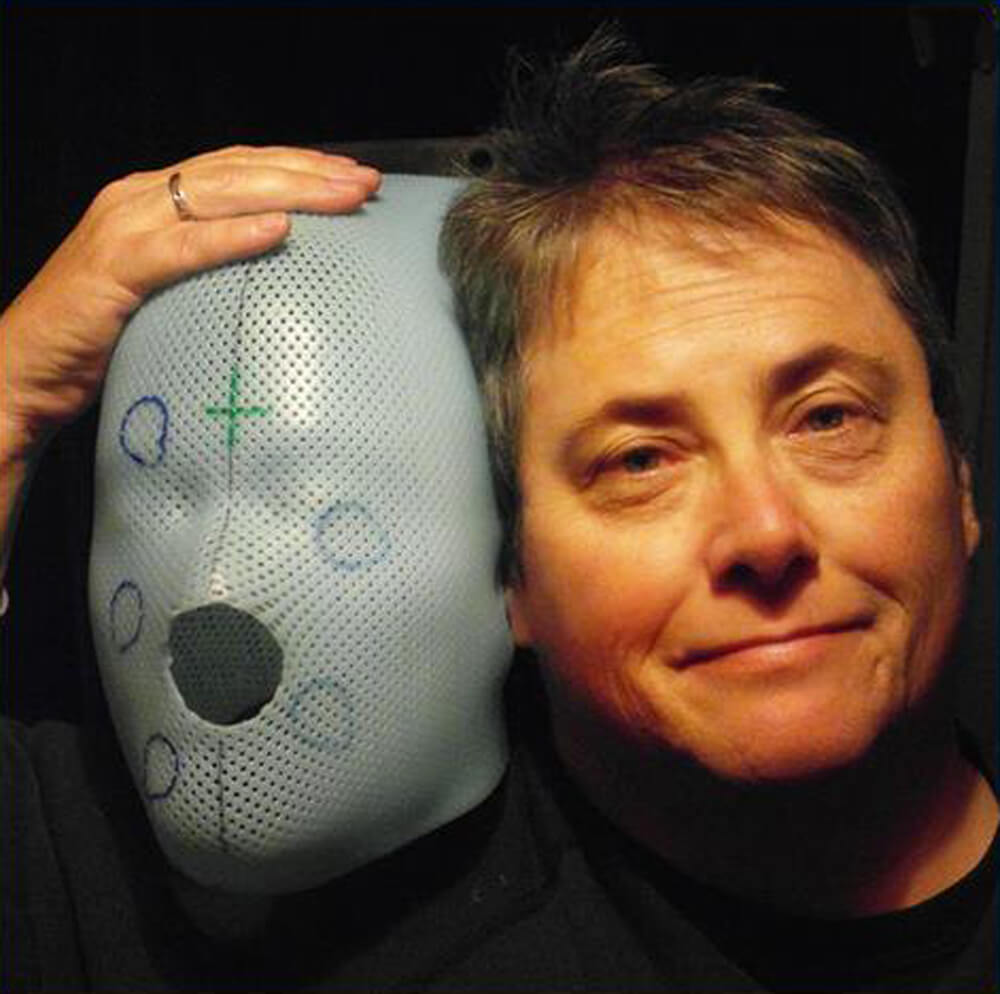
The reason for having to retire early is a brain tumour that still lives in my head today. It is a meningioma and is non-malignant but inoperable, so, finally, after a two-and-a-half-year wait, I had radiotherapy back in 2013 at the Royal Marsden Hospital in Kensington, to halt its growth. So far, Algy – the name I gave my tumour – has been halted in his tracks but has still left an amount of damage that includes occasional absence seizures, vertigo and quite severe neuralgia in the right side of my head, mostly in the face.
Living with the impact
The last ten years have not always been easy, with depression caused in part by endless battles with the Department for Work and Pensions. I gave up the battle after five years, as it was severely affecting my mental health, which included suicidal thoughts in my darkest moments.
However, I consider myself to be lucky. I have come to know so many who have not been so fortunate. There are over 120 different types of brain tumour, and it remains one of the most common cancer killers in children and adults under the age of forty. It can be difficult to diagnose, and so much more is needed in terms of research and care.
One of the things I have been able to do over the years is volunteer, including as an ambassador for Brain Tumour Support.
I can still give my time, and although pain, depression and fatigue can sometimes get in the way, that has not stopped me yet.
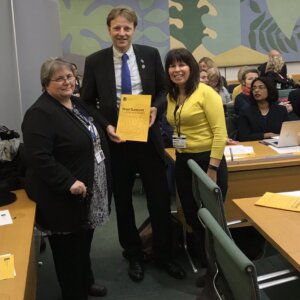
Heather, Derek Thomas MP, and Tina Mitchell Skinner, Brain Tumour Support Founder, at APPGBT in 2018
Helping to campaign
One of my roles is to attend the All-Party Parliamentary Group for Brain Tumours (APPGBT) in Westminster and report back to the charity on the proceedings. My local MP, Derek Thomas, is, by coincidence, chair of the group, and from there, much is done to raise awareness about brain tumours and the dire need for better funding for research and care for those affected.
I have learned so much from these meetings, and some of it is utterly heartbreaking. Some are hopeful, though, and not everyone with a brain tumour has an automatic death sentence hanging over them. But there are still numerous problems with health, relationships, work, disability and other issues that can be as individual as the type of tumour the patient has.
Putting experience to good use
Most of us who volunteer with the charity have our own experiences with brain tumours which means we understand a lot of that. And although I of course wish my nursing career hadn’t been cut short, I love volunteering because I feel useful again and can help support others going through what is a terrifying ordeal.
Heather Taylor-Nicholson | March 2021
Could you volunteer with us?
Every volunteer makes a difference.
Whether you can spare a few hours a month, share your skills or support local fundraising and awareness activities, there are many ways to get involved and help people affected by brain tumours.
Become a volunteer