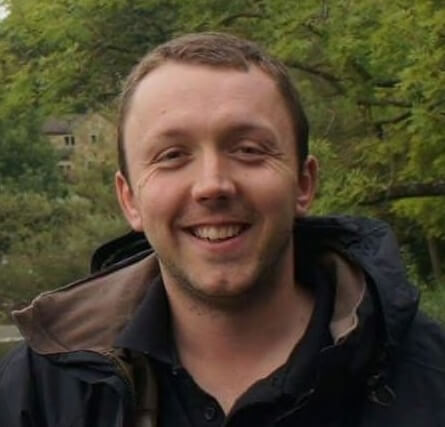
Alex’s story
Alex was diagnosed with a colloid cyst in 2022, but it was only recently, with the news of Davina McCall undergoing surgery for the same type of brain tumour, that he appreciated just how rare it was. Alex told us about his experience of suddenly being in ‘The exclusive club that no-one really wants to be a member of…’
What exclusive club?
You may have seen in the news that Davina McCall has recently undergone a procedure to remove a rare brain tumour called a colloid cyst. I never appreciated exactly how rare it was, until I read the BBC News article myself – and my friends all got in touch asking questions. Their questions came to me because that’s the exclusive club I’m in, but which I didn’t really want to join.
I have also had a colloid cyst, which was removed back in May 2022. The difference between Davina and myself being, that I had no idea I had one or what one was, until I woke up in Southampton Neurology ICU with a variety of tubes connected, one of which was through the top of my head.
The night that life changed
I was a normally fit and well 37-year-old male, working as a civil servant, volunteering with the Cadet Forces, RAYNET and local Lowland Search and Rescue groups.
The first weekend in May 2022 I was teaching on a cadet communications course and felt a bit rubbish on the Sunday afternoon. I had one of “those” headaches that I would describe as typically getting from not drinking enough during the day except it progressively got worse. So, I finished the course, packed everything away, awarded the qualifications, and drove home with a pounding headache that I could not shift. I vaguely remember taking some pain killers, not being able to keep them down and going to bed early that night.
I have about 20 minutes of vague memories from the following day, Monday 2nd May 2022, starting with paramedics leading me down the stairs at home and out into the side of their ambulance. It was dark and around 1am. I can expressly remember the ambulance moving off and the paramedic telling me we were on the way to Dorchester hospital, but we weren’t there yet. My next memory was in Southampton Neurology ICU at 10.30pm, where I came round, surrounded by equipment and the nurse on duty who was called Maria!
A walnut and a teaspoon
What had happened was I had a colloid cyst that suddenly had an internal bleed and expanded inside the middle of my brain, inside an area of the brain called the third ventricle. This is where colloid cysts are generally found, and they are normally very slow growing so it is quite possible to have one and it never become an issue, or that the risk of surgery outweighs the benefit of removal! They are typically found during teenage years when investigating constant headaches, but no one knew mine was there as I had never had a reason to have any MRIs of my head.
So I had absolutely no sign until it went seriously wrong.
I was told my tumour had ended up being about the size of a walnut, inside the space of a teaspoon. The brain creates fluid when there is a problem, but, given that the tumour was blocking everything, that fluid had nowhere to go and so my brain was effectively being pumped up from the inside and being compressed against my skull.
Two emergency surgeries
The first emergency operation was to tackle the pressure. I was kept in a high dependency neurology ward for a week while they were draining the excess fluid from inside my brain, to relieve the pressure and let things settle down a bit. After four days around a pint and a half of fluid had been drained.
-

- The drain to relieve pressure
-

- Alex after removal of the colloid cyst
A week after the drain had been put in, I went for a second round of emergency surgery, this time to remove the tumour and the drain that had been fitted. It was successful and I was discharged 48 hours later!
The shock of a seizure
Unfortunately, that was not the end of the episode. I had a full body seizure the following week, which meant another overnight stay in hospital where more checks were carried out and I was put on extra medication. In total I was taking around 17 tablets spread out over 24 hours.
My quality of life and mental health was completely in the gutter, as I was suddenly not that active and independent person that I had been for the last 37 years and had to depend on others for pretty much everything as my mobility and function was so limited.
Crucial support on the long road to recovery
My recovery journey then began properly. I self-referred to the Acquired Brain Injury Rehabilitation Service in Dorset and was given exercises to do to get my brain and head used to movement again. I also joined various support groups online, including Brain Tumour Support and the Brain Tumour Charity, which I continue to be part of, supporting others on a regular basis.
Given the sudden impact on my mental health and quality of life, I returned to work after five weeks on reduced hours to give me something worthwhile to do and occupy my time. The support and understanding that I’ve received there has been crucial.
Due to where my tumour was, it has affected several other functions including my memory and language skills, and the seizure meant my driving licence was revoked. Those that work with me have been amazing by providing transport into work, when I was unable to drive, and continue to give me the additional support and adjustments that really make the difference.
-
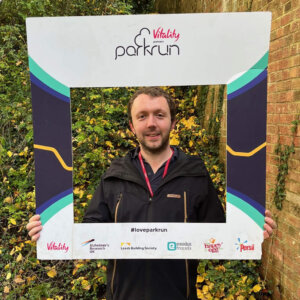
- 6 months after surgery, Alex’s first Parkrun
-

- Exactly a year post-surgery, Alex co-pilots a glider, thanks to his cadet colleagues
Value of connection
I am now over two and a half years down the road of recovery, and still have issues with my short-term memory and fatigue that can drain me of what little energy I have.
I have had to focus on putting me first and looking after myself, which is no bad thing. In recovery though, the value of connecting with others is huge. I think that the difficulties I have faced can only really be understood by others that have experienced something similar, as it is just so difficult to explain and fully understand.
I was able to find only one other person who had had a colloid cyst, so Davina brings my count to three! However, since my diagnosis I have discovered that others in my life have also been affected by many different brain tumours, and I’m sure there are many more out there.
It really brings it home, the impact and after effects from something so invasive and central to being able to function.
Alex May | March 2025
Brain tumours can affect any one of us, irrespective of age, lifestyle or general health. Every 40 minutes someone in the UK receives this shocking diagnosis, and when faced with the words ‘You have a brain tumour’ the right support to help navigate the path ahead is vital.
Brain Tumour Support wants to ensure that no one feels alone at any stage of that journey. So if you are able to make a donation, helping us to be here for more people like Alex, we would be very grateful. Our support services are always free to access and rely on the generosity of fundraising and donations to be maintained. Thank you so much.
Make a donation