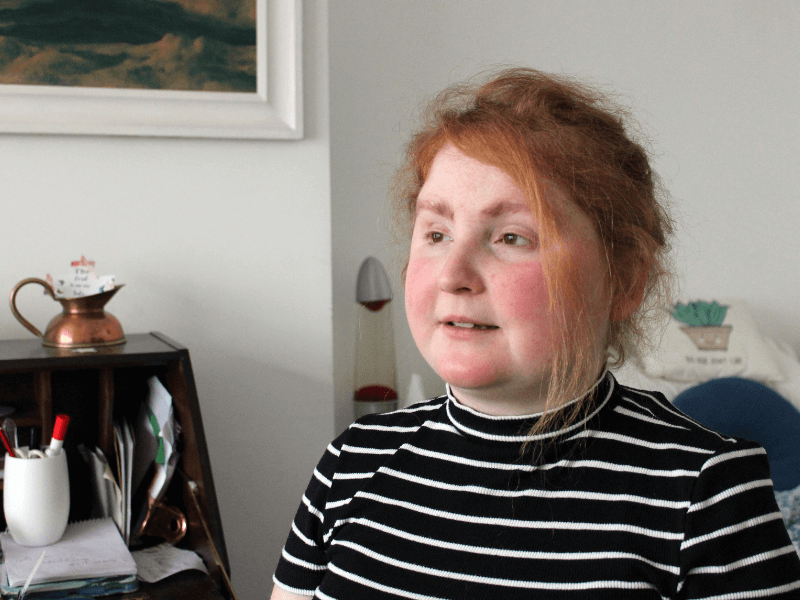
Elena’s story
Elena was diagnosed with a brain tumour just as she was about to go to university. At the age of nineteen, she didn’t know how much that diagnosis would shape her life, but she shared her thoughts in 2015, when attending her first-ever support group, and eleven years on, reflecting on her experience and the support that continues to help her.
We’re extremely grateful for Elena’s openness and generosity in sharing her story, so that more people can gain a better understanding of the impact that brain tumours have on so many young lives.
Diagnosis
In 2015, Elena was nineteen and, after having a gap year working abroad, she was about to take up a place to study psychology at university.
She had experienced some fatigue, headaches and a bit of difficulty with patchy vision, but nothing that either her GP or the optician could identify, so she was referred to a neurologist for an MRI scan. The day after the scan, Elena got a call to say that she needed another emergency scan because they’d seen a mass on her brain and they wanted it to be dealt with as soon as possible.
It was a shock getting that news over the phone, just in my lunch break but I think it was more of a shock to my mum and my family. Because I think when you’re put in that situation, you just deal with it.
After the second scan, it was a couple of weeks before Elena got an appointment to be told more information.
That was quite a long wait, even though it was just about two weeks, waiting that long seemed too long for me.
At the appointment with her consultant, she was shown how big the tumour was – it was very large and they said likely to have been growing for several years. The treatment plan was for surgery, most likely to be done by going up through her nose, which would be less invasive than through the skull.
Surgery
A few weeks later, after a couple more scans and health checks, Elena went into surgery, learning ten minutes before going into theatre that, as hers was a rather uncertain case, the operation would actually be going through the skull.
So they had decided last minute to change it, which was a bit of a shock to me then because I knew of the longer recovery time and surgery difficulties with it.
The tumour was a pilocytic astrocytoma, a slow-growing, low-grade brain tumour.
Connecting with others
Just a few weeks after the operation, Elena came along to the Brain Tumour Support Group in Bristol, and talked then about the benefits of attending even though she has great support from her family and friends.
-

- At the support group in 2015
-
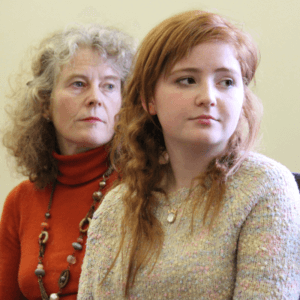
- Elena with her mum Hillevi
-
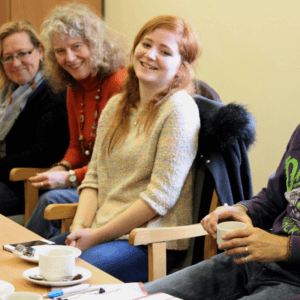
- Sharing laughter too
For me, the Brain Tumour Support Group means just sharing experiences with people who’ve had something very similar. And that’s a type of support you just can’t really get from friends and family. You can get a very positive support from friends and family, but it’s a type of understanding which they can’t give, I think. It’s this power of meeting complete strangers and being able to connect with them straight away, which is something quite unique.
I’ve never been to a support group before, so I was very nervous coming, but I was welcomed and greeted very nicely. And I can imagine for the next couple of years, it’ll be a very, very supportive group to come to, and very helpful psychologically.
A gruelling 2016
Unfortunately, in May 2016, scans showed that Elena’s tumour had unexpectedly grown. She was put on steroids and told she needed immediate surgery. This was a shock for Elena and her family as they were hoping for further treatment through proton beam radiotherapy, which they would have to go to Switzerland for, but had been advised that there would be no further operations.
Despite the setback, Elena was still hoping to take up the university place which was held for her in Liverpool in September.
Through summer 2016, Elena had complications which involved lengthy hospital stays, a third operation and finally travelling to Switzerland for proton beam treatment. Then, after returning home, she faced six cycles of chemotherapy, starting in October 2016.
Her university plans were held over for another year.
Hopes for 2017
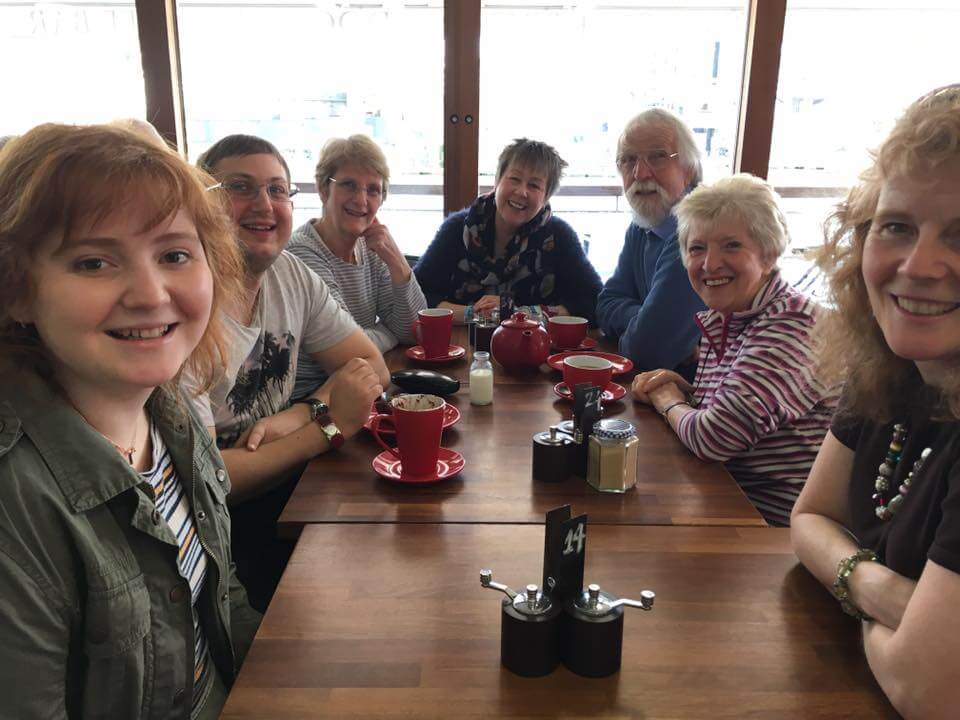
Elena enjoys a support group social in Spring 2017
The impacts of the brain tumour and gruelling treatment were considerable for Elena. Her sight was badly affected, and she continued to suffer from fatigue and very poor memory. In a year when lots of her friends were graduating, the frustration of her situation was particularly highlighted.
Elena, however, didn’t want to give up those ambitions, and when she attended the Brain Tumour Support Group in September 2017, she was eagerly anticipating moving to halls and finally starting university.
Sadly, though, the amount of information and work involved proved too much, and she had to give up her course later that year.
Life as a young person
This diagnosis at such a pivotal time puts up barriers to the life that any young person has ambitions for and looks forward to.
I’ve had some very good friends stuck through it and yeah, been by my side. I think it’s been difficult because they’ve moved on with their life, you know, they’ve gone to university, they’ve gone and got careers now, living in different cities. So even when I see them when they’re back, it’s changed because they’re at a different point in their life completely. So even though we still get on as friends, it’s harder to relate to each other.
Keeping your head up
I think I’ve managed to put on quite a good front. You put on a mask for other people, you know, to get through those hard days. You just have to look to the future, I guess. Keep your head up.
Though I’d say, yeah, if you catch me on a bad day, you’d see I’m not so positive. I definitely put on a front, which sometimes helps me and sometimes does exactly the opposite. But people try to be kind, and like to look at the positive of things – and if there’s no positives, then it’s difficult to have a chat with someone about how things are going.
Long-term support
Since 2017, Elena has had to face regular scans, further operations and ongoing medication to help with the fatigue, memory and sight issues which she lives with.
During the Covid pandemic, when face-to-face support groups had to be put on hold, she was pleased to join our online groups, and then, when social meet-ups and in-person groups could start again, she returned to our Bristol support group, which she still attends regularly.
It’s just about getting together and saying, you know, this is rubbish but we can still get through it because we’ve got each other. People who don’t just understand the medical side of it, but understand how tumour can affect every single corner of your life, every single corner.
Elena also benefitted greatly from Brain Tumour Support’s specialist counselling service, which she’s been able to return to throughout the most challenging periods of her illness.
As a young person having the counselling, I mean for anybody, but especially for a young person, that helps to be able to talk about those really tricky subjects which you can’t talk about with family and friends because it’s too painful for them….The amount of things that are changed in life because of the diagnosis.
Impact on the whole family
The impact of a diagnosis is very much felt by family and friends too. In returning home and with her mum becoming her main carer, Elena felt this acutely.
I think it’s changed their life just as much nearly as it’s changed mine. You know, they take on so much of my pain and the effects that the tumour’s had on me. And then you realise how much a tumour can then affect every relationship and other people in your life, especially those close to you, like family.
And they’re not just looking on, you know, they’re experiencing it with me, because they’re my parents, there every day helping me. So, yeah, a big, big weight on their shoulders, I think.
Moving forward
Elena is now living independently – after ten years of wonderful care from her family, but ten years longer than she expected, she has been able to move into assisted living accommodation.
I feel grown up finally – after having moved out from home when I was 18, lived abroad, worked abroad and then coming back home and having to be looked after the whole time. It’s nice to be living away from home, but still be supported, being in such a nice house and with lovely people who live here.
Thinking of the future
There’s been so much in the past where I’ve planned for the future in the last 15 years, but especially in the last 10 years – planned things, hoped for things and they haven’t been able to be fulfilled because all the boundaries, physical and so many different parts of life that have been affected that it really doesn’t feel like I have a lot of control. I can hope and I can have ideas, but I feel quite out of control of the future.
But no further treatment at the moment, which is good. And you just have to live with the impact.
Brain tumours can affect any one of us, at any stage of life. Every 40 minutes, someone in the UK receives this diagnosis, and when faced with the words ‘You have a brain tumour’, the right support to help navigate the path ahead is vital.
Brain Tumour Support wants to ensure that no one feels alone at any stage of that journey. In Brain Tumour Awareness Month, and beyond, please help us to improve understanding and support for the thousands of families affected every year.
And if you can donate, helping us to be here for more people like Elena, we would be very grateful. Our support services are always free to access and rely on the generosity of fundraising and donations to be maintained. Thank you so much.
Make a donation