Tina’s story
I popped into Mum and Dad’s for a cuppa on my way home from work and noticed that Mum didn’t seem herself.
She seemed unsteady on her feet, a little vague, lost for words and referring to me as “egg”. I laughed as I corrected her, “Mum, it’s Tina, why are you calling me an egg?” She laughed too, telling me she was just tired.
My mum was 64 years old, full of fun, enjoying holidays with dad, shopping trips, babysitting the grandkids and her nights at Bingo.
We finally managed to persuade Mum to see a doctor and before we knew it she was admitted to the hospital.
It was on 24 June 2008. “You appear to have a very aggressive brain tumour, a GBM4,” said the consultant. “In fact, we can see two large masses and three more developing.”
It was too much to take in. I didn’t want to ask any questions as I was too scared to hear the reply.
I had been having tests myself earlier in the year for an autoimmune disease and part of the test had been a brain scan. The scan had shown an irregularity and I had been told in a matter-of-fact way that I had a benign brain tumour, a meningioma.
“Don’t worry it’s nothing to worry about, it’s small and you were probably born with it! Go home, don’t think about it and we’ll repeat the scan in six months to reassure you.”
So I ignored it. Left it unmentioned and got on with my life.
Mum was deteriorating and in July 2008 palliative care was put into place. This was the same day as my repeat MRI for my ‘insignificant’ benign tumour.
I felt terrified at the thought of losing my mum. I stayed day and night by her side watching her die. On 14 July Mum slipped away peacefully.
I felt lost, cheated, angry, misled. Why didn’t she get a second chance? Had we missed earlier signs? Could we have done more, and insisted on surgery?
An envelope from the hospital
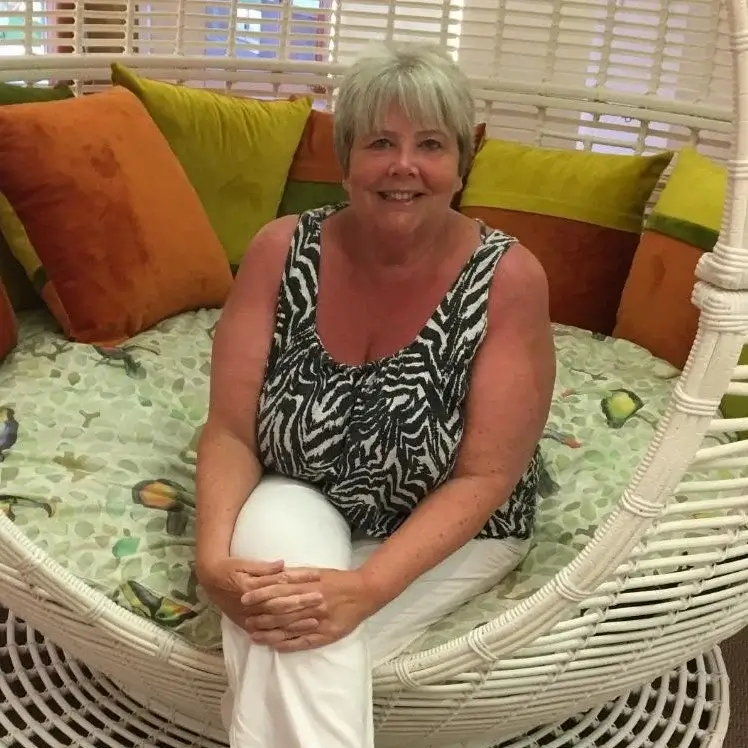
Tina today: “Lockdown may be easing for many, but is a way of life for me and thousands like me. And it always will be.”
Mum’s funeral was on 25 July. We played out to “Yesterday” and the words stayed in my head. At home, I put the kettle on and looked at my post – an envelope from the hospital. I opened the letter and started to read: “Please contact us as soon as possible. Your recent MRI shows that your tumour has grown.”
I threw the letter into the bin and didn’t mention it to anyone. My dad was so sad and lost without Mum. My eldest daughter was eight months pregnant and my youngest daughter was eight years old.
My head was all over the place. Denial was the only option.
I had several missed calls from the hospital but I chose to ignore them.
In September I received a call from a neurosurgeon. He was so patient explaining Mum’s tumour and the difference with mine and reassuring me. He talked me through my options and assured me that, despite it growing, it was still quite small and we should watch and wait.
But then in 2010, it had a growth spurt. It was suggested that the best treatment would be stereotactic radiotherapy as the tumour was sat on a vital structure (an artery). I should have my life back within three months and my driving licence within six months. It all sounded very simple, quick and safe.
I was very careful to reassure my dad and children that it was all positive and nothing to worry about.
In November 2010 I was admitted to oncology for the procedure. A frame was attached to my head and the stereotactic radiotherapy was performed. Though exhausted, I was back on the ward the same afternoon; everything seemed to go well.
After another night in hospital, I was discharged with a high dose of steroids for three weeks.
Another challenge
Initially, all seemed well but two weeks later I began to feel very unwell. Awful headaches, nausea, fatigue, forgetfulness and more.
We were told that I had had an adverse reaction to the radiotherapy – possibly the worst case they had ever witnessed.
I had a huge seizure and was rushed to hospital. My neurosurgeon was on holiday but flew home to perform my emergency craniotomy.
The procedure was successful but they had to leave a section of my skull off to allow space for my brain to swell. A plate was made to replace the missing piece of the skull once the brain swelling was reduced. But my brain likes sticking out and has refused to go back in! It would take a few operations to resolve this so initially I wore a helmet to protect my brain.
Nowadays I am more confident – you can’t see it pushing out as it’s well hidden by my skin and hair.
I try always to remain positive as not everyone gets a second chance. I feel guilty … how did I get a second chance when others didn’t…when my mum didn’t?
Finding support
My life, and the life of my family, has been affected in so many ways. The brain tumour robbed me of my driving licence and the job I loved. I lost more than half my sight in both eyes. I lost some mobility and my independence. I miss not being able to read go out alone or drive to the shops.
I miss taking my grandchildren out for the day. I miss helping others with physical things, mowing the lawn, decorating, and dancing at parties. But I gained an understanding of what is important. Time with family and friends.
I’m less judgemental. It’s easier to understand loneliness, sadness, the need for space or a listening ear.
That’s why I found great comfort in attending my local Brain Tumour Support Group. Before lockdown, I used to always look forward to meeting with everyone. It’s such a positive experience and I always come home feeling that I’m not alone in my journey. I’ve made so many friends – patients, carers and their families and Sarah our group leader. I’ve enjoyed activities, entertainment, lectures and more. There’s the opportunity to ask questions and seek counselling. It’s truly fabulous.
Since the coronavirus lockdown, the charity has been offering virtual groups. It’s great that this support still exists as it is helping so many people.
Yes, the brain tumour has greatly affected me and my family, but thanks to the support I have had from family, friends, support groups and the NHS, I have a great appreciation of what matters and what’s important.
The coronavirus pandemic has given many people a flavour of what it is like living with a serious health condition that limits your independence and your ability to interact with others.
Lockdown may be easing for many, but is a way of life for me and thousands like me. And it always will be.